

Solution For Business Consultation

















How Different Types of AI Services Can Help Your Business
How Different Types of AI Services Can Help Your Business
What Are AI Services?
AI services are basically tools that use artificial intelligence to help people with different kinds of work. They can do things like read text, check and understand data, recognize speech, find patterns, create content, and answer questions. So, we can think of AI as a kind of digital helper that can make some tasks easier.
One useful thing about AI is that it can deal with a lot of information in a short amount of time. It also does not get tired like a person does. Different technologies are used to make AI services work, such as machine learning, language models, and computer vision.
For businesses, AI can be helpful in many ways. It can save time, reduce some of the manual work, help solve problems, and support better decision-making. A company also does not always need to create its own AI system. There are already many AI services available that can be connected with the software and tools a business is using.
Why Businesses Use AI Services
Businesses use AI services mainly because they can save time and make work easier. In many companies, employees have to do the same tasks again and again, like answering common customer questions, entering information, checking documents, or going through reports. AI can help with these types of tasks, so employees can spend more time on work that needs human thinking and decision-making.
AI can also help businesses understand their data better. Sometimes it can find things that may be difficult for a person to notice. For example, it might show that sales are increasing in a certain area or point out a payment that looks unusual. This can help a business take action faster and provide better service to its customers.
However, AI cannot do everything on its own. It is a tool that needs proper guidance. People still need to check the results and make sure the information is correct before using it.
Types of AI Services
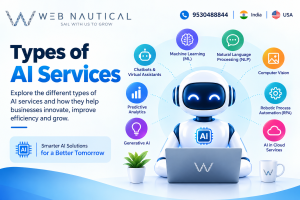
There are different types of AI services, and each one is useful for a different kind of work. Some AI tools mainly deal with numbers and data, while others can work with text, images, sound, or customer questions. A business can use just one AI service or use several of them together.
For example, an online shop could use a chatbot to answer customer questions, a recommendation system to suggest products, predictive analytics to plan sales, and AI tools to understand its reports. Choosing the right AI service depends on what the business actually needs. It is similar to using tools from a toolbox. You would not use the same tool for every job, and AI works in a similar way. Businesses should think about their needs, available data, budget, and the skills of their team before choosing an AI service.
Machine Learning Services
Machine learning services allow computers to learn from data and find patterns in it. Instead of telling the computer exactly what to do in every situation, the system is given examples and learns from them.
Businesses can use machine learning for things like predicting sales, checking risks, understanding customers, or estimating product demand. For example, a shop can look at its previous sales and use that information to guess which products might sell more next month.
One of the main advantages of machine learning is that it can look through a large amount of data much faster than a person. However, the data needs to be useful and accurate. If the data is poor or outdated, the results may not be very helpful.
Natural Language Processing (NLP)
Natural Language Processing , usually called NLP, helps computers understand and work with human language. It can be used to read text, sort messages, translate information, and find important details in documents.
For example, a company could use Natural Language Processing (NLP) to look at customer reviews and find out what customers like or do not like. It could also be used to sort support emails and send them to the correct department.
Email sorting is a simple example. Instead of an employee checking every email manually, an NLP system can group emails based on their topic. This can save time, especially when a company receives a large number of messages every day.
AI Chatbot Development
AI chatbots are programs that can communicate with customers or employees through text or sometimes voice. They are designed to understand questions and give useful answers.
For example, an online store might have a chatbot that answers questions about orders, prices, returns, or business hours. If a customer asks, “Where is my order?”, the chatbot may check the order information and provide an answer.
A chatbot can also work outside normal office hours, which can reduce waiting time for customers. However, not every problem can be handled by a chatbot. If a customer has a complicated issue, it is better for a human employee to take over.
Computer Vision Services
Computer vision helps computers understand information from images and videos. It can be used to recognize objects, read text from pictures, check products, and notice visual differences.
For example, a factory could use computer vision to check products while they are being made. If the system notices that something looks damaged, it can mark the product for further checking.
Stores can also use computer vision to check shelves or keep track of stock. This type of AI is especially useful when there are many images or videos that would take people a long time to check manually. Even so, human checking is still important when accuracy or safety is involved.
Predictive Analytics
Predictive analytics uses existing data to make an estimate about what might happen in the future. It does not actually know the future. Instead, it looks at older information and tries to find patterns that can help with future decisions.
For example, a company can look at previous sales, customer activity, seasonal changes, and other information to estimate future demand. A shop might use this to decide how much stock it should keep.
Usually, the process involves collecting the data, cleaning it, looking for patterns, and then creating a model. Predictive analytics can be useful for planning and can help businesses avoid waste or notice possible problems earlier.
AI-Powered Robotic Process Automation
AI-powered robotic process automation, sometimes called intelligent automation, combines normal software automation with AI. Traditional automation usually follows a fixed set of rules, while AI-based automation can handle tasks that require some understanding.
For example, a system could read an invoice, find the important information, check it, and send the details to the correct software. This can be useful for a finance department that receives hundreds of invoices.
Instead of entering everything manually, employees can let the system handle much of the routine work. This can save time and reduce small mistakes. It is most useful for tasks that happen regularly and follow a fairly clear process.
Speech Recognition Services
Speech recognition services turn spoken words into text or digital commands. Businesses can use them in call centres, meeting applications, mobile apps, and other systems.
For example, a company could record customer calls and use speech recognition to create written transcripts. These transcripts can then be searched for important words or topics.
Voice assistants are another common example. The system listens to speech and uses an AI model to work out which words were spoken. This can reduce typing and make spoken information easier to store and search. It is especially useful for businesses that deal with many phone calls or meetings.
Recommendation Systems
Recommendation systems suggest products, services, videos, articles, or other content based on information about the user. Most people have probably seen this type of system while shopping online or watching videos.
For example, if someone looks at a pair of shoes on an online store, the system might suggest similar shoes or other products that could be useful. It can use information such as what the person searched for, viewed, purchased, or liked.
This can make the experience more personal and can also help customers find useful products without looking through a huge list. Recommendation systems work better when a business has enough information about its users and products.
Generative AI Services
Generative AI is used to create new content based on a user’s instructions. It can create things such as text, images, audio, summaries, and computer code.
For example, a marketing team might use it to come up with ideas for a campaign. A customer service team could use it to prepare a first draft of a reply, while a developer might use it to understand or write some code.
Generative AI can save time, especially when someone needs a first draft or some ideas quickly. However, the output should not always be trusted without checking it. Sometimes AI can give incorrect information or produce something that does not fit the situation. So, it is better to use it as a helpful tool rather than depend on it completely.
AI Data Analytics
AI data analytics helps businesses understand large amounts of data. Regular reports can tell a company what has already happened, while AI tools can also help find unusual changes, patterns, and possible trends.
For example, a company could use sales information, customer data, and website activity to understand which products are doing well. The system could also notice a sudden change that needs to be looked at.
This can be useful for managers who need information quickly. AI data analytics works best when the business has good-quality data and knows what questions it wants to answer.
AI Integration Services
AI integration services help connect AI tools with software that a business is already using. This is useful because an AI tool is not very helpful if it works separately and cannot access the information the business needs.
For example, a chatbot could be connected to an online store’s order system. When a customer asks about an order, the chatbot can use the information from that system to give an answer.
Integration makes AI part of the normal business process instead of keeping it as a separate tool. It can be useful for companies that already have software such as customer management systems, accounting programs, websites, or internal databases.
Custom AI Development Services
Custom AI development means creating an AI system for a particular business or problem. Instead of using a general AI tool, the company can build something based on its own data and requirements.
For example, a delivery company might create an AI system that tries to predict delays by looking at routes, delivery times, and previous shipment information.
A custom system can be useful when a business has a very specific problem that ready-made AI tools cannot handle properly. However, building one can take more money, time, testing, and technical knowledge.
Because of this, custom AI is not always the best option. If a simple ready-made service can do the job, it may be easier and cheaper to use that instead.
How to Choose the Right AI Service for Your Business
Choosing an AI service starts with the problem, not the technology. First, ask what is taking too much time or causing repeated mistakes. Then look at the data needed to solve it. Next, consider cost, security, ease of use, and how the service will fit with current software. A small business may benefit from a simple chatbot or AI writing tool, while a larger company may need predictive analytics or custom development. Start small when possible. Test the service on one clear task before using it across the whole business. This gives the team time to learn. It also makes it easier to spot problems early and improve the process before expanding.
AI Services by Business Use Case
AI can support many parts of a business, but the best service depends on the job. Customer support may need chatbots and NLP. Sales teams may benefit from prediction and recommendation tools. Finance teams may need automation and fraud detection. Data teams may use AI analytics to find trends. The important thing is to match the tool to the work. Do not add AI simply because it is popular. That can create more work, not less. Start with a real business need. Look at the current process. Find the slow parts. Then decide where AI can help. It is a simple approach, but it often works better than chasing every new AI trend.
Customer Support
AI can make customer support faster by handling common questions and sorting incoming requests. Chatbots can answer simple questions at any hour. NLP can read messages and send them to the right team. Speech recognition can turn support calls into text, which makes them easier to review. A business might use all three together. A customer asks about a return, the chatbot answers, and a more complex issue is sent to a human agent. The benefit is not removing people from support. It is helping them focus on cases that need care. Use AI when support teams receive many repeated questions and need a faster way to manage the daily flow.
Sales & Marketing
Sales and marketing teams can use AI to understand customers, find patterns, and create content faster. Recommendation systems can suggest products. Predictive tools can help sales teams focus on leads that may be more useful. Generative AI can help create first drafts for emails, ads, product descriptions, and social posts. AI can also study customer behavior and show which campaigns perform well. For example, a retailer may learn that a certain group responds better to a particular product offer. That insight can guide the next campaign. AI is useful here because marketing creates lots of data. The trick is turning that data into clear action instead of another giant report nobody reads.
Business Automation
Business automation uses AI to reduce manual work across daily processes. It can help read forms, sort emails, update records, check documents, and move information between systems. A company that receives many invoices, for example, can use AI to read invoice details and send them into its finance system. Staff can then review the results instead of entering every field by hand. The same idea works in HR, sales, support, and operations. Automation is most useful when a task is repeated many times and follows a clear process. Start with one workflow. Measure the time saved. Then expand. Small wins can build trust much faster than a huge change made all at once.
Data Analytics
AI-powered data analytics helps businesses understand what their numbers are saying. It can combine data from sales, customers, websites, stock, and other sources. The system may find patterns that are easy to miss in a normal spreadsheet. For example, it might show that sales fall after a certain delivery delay or that a product performs better in one region. Managers can use these findings to make better plans. AI analytics is especially helpful when data keeps growing faster than a team can review it. The goal is not to create more charts. It is to find useful answers. Good analytics should help someone make a decision, take action, or ask a better question.
Fraud Detection
Fraud detection uses AI to spot unusual behavior in payments, accounts, and transactions. The system studies patterns and can flag activity that looks different from normal behavior. A payment made in an unusual place, a sudden change in spending, or many fast transactions may need a closer look. AI can review huge numbers of transactions much faster than people can. Banks, online stores, and payment companies often have a strong need for this kind of service. The system should not blindly make every decision, though. False alerts can affect real customers. Human review and clear rules still matter. AI works best as an extra layer of protection that helps teams focus attention where it matters.
Forecasting
Forecasting uses data to estimate future demand, sales, costs, stock needs, or other business measures. It can help a company plan instead of simply reacting to events. A store might forecast demand before a busy holiday period and order stock based on that estimate. A logistics company could predict shipment volumes and plan staff or vehicles. AI forecasting looks at past patterns and may include other useful signals, such as seasons or customer activity. It is most useful when a business has enough historical data and needs to plan ahead. Forecasts are still estimates. Things change. Good teams use them as guidance and update them as new information comes in.
AI Services by Industry
Different industries have different problems, so AI services are used in different ways. A hospital may need tools for records, images, or patient support. A bank may focus on fraud, risk, and customer service. An online store may care about recommendations and demand forecasts. Schools can use AI for learning support and administration. Property firms may study market data, while logistics companies can work on route planning and delivery forecasts. The basic idea stays the same: find a useful problem, choose the right AI tool, and fit it into the existing process. Industry knowledge matters too. An AI system should understand the rules, risks, and needs of the field where it is used.
Healthcare
Healthcare can use AI services to support many tasks, from document work to image analysis and patient communication. NLP can help organize medical text and extract useful information from records. Computer vision can assist with the study of medical images. Chatbots may help patients find basic information or manage simple requests. Predictive tools can also help teams study trends in patient data. These tools should support trained healthcare professionals rather than replace their judgment. Health data is sensitive, so privacy and security are especially important. Use AI carefully, with strong checks and clear limits. In this field, speed is useful, but accuracy, safety, and human review must come first.
Finance
Finance companies can use AI for fraud detection, customer support, risk analysis, forecasting, and document processing. A bank may use AI to flag unusual transactions. A finance team may use automation to read documents and enter key information into a system. Predictive models can help study risk and customer behavior. Chatbots can also answer simple account questions. These services can handle large amounts of information very quickly. But finance is a sensitive area. Poor data or weak models can lead to serious problems. Human oversight, testing, privacy controls, and clear rules are important. AI should make financial work more efficient while keeping trust and careful decision making at the center.
E-commerce
E-commerce businesses have many opportunities to use AI. Recommendation systems can suggest products based on browsing and buying behavior. Chatbots can answer order questions. Predictive analytics can help estimate demand and manage stock. Generative AI can help create product descriptions and marketing drafts. Computer vision may help with product images or quality checks. A simple example is a customer viewing a laptop and then seeing useful accessories suggested below it. That small suggestion can improve the shopping journey. AI works well in e-commerce because online stores create large amounts of customer and product data. The key is using that data in a useful way without making the shopping experience feel strange or overly personal.
Education
Education can use AI services to support students, teachers, and school teams. AI tools can help explain topics, create practice material, summarize notes, or answer common questions. NLP can help with language tasks, while analytics can help teachers spot learning patterns. Automation can also reduce routine administrative work. For example, a school may use AI to sort basic requests or organize large sets of records. Human teachers remain very important because learning is more than giving answers. Students need context, feedback, motivation, and real support. AI should add to that experience. It should not become a shortcut that stops students from thinking, asking, trying, and learning for themselves.
Real Estate
Real estate companies can use AI to study property data, predict market trends, answer customer questions, and improve property searches. Recommendation tools can show buyers homes that match their needs. Predictive analytics can study prices, demand, and local patterns. Chatbots can answer basic questions about listings, viewings, or property details. AI can also help agents sort large amounts of property information faster. For example, a buyer searching through hundreds of listings may receive a smaller set of options based on location, price, and preferences. The value comes from reducing search time. Still, property decisions involve money and personal needs, so agents and buyers should review AI results before making important choices.
Logistics
Logistics companies manage routes, vehicles, shipments, warehouses, and delivery times. AI can help with many of these jobs. Predictive analytics can estimate shipment demand. AI forecasting can help plan staff and vehicles. Route systems can study traffic, distance, and delivery needs. Computer vision can support warehouse checks, while automation can move data between systems. Imagine a busy delivery center with thousands of packages moving each day. Small planning mistakes can quickly become expensive. AI can help teams spot patterns and respond faster. It is most useful when connected to real operational data. Human teams still need to handle unusual events because roads, weather, customers, and supply chains can change without warning.
Benefits of AI Services for Businesses
AI services can bring several practical benefits. They can reduce repeat work, speed up data analysis, improve customer response times, and help teams find useful patterns. Automation may free staff from dull tasks. Predictive tools may help managers plan ahead. Chatbots can answer common questions while human agents deal with harder cases. AI can also help a small team do work that once needed a much larger group. But the value depends on the problem being solved. A poor process with AI added to it is still a poor process. Businesses should first understand the workflow, then use AI where it can make a clear difference. That approach keeps the focus on useful results rather than hype.
AI Services vs Custom AI Development
AI services and custom AI development are not the same thing. A ready-made AI service is usually built for common tasks and can be faster to start. It may work well for chat, text creation, analytics, speech, or recommendations. Custom AI development is built around a specific business need. It can use special data and follow a unique process, but it often needs more time, technical skill, testing, and money. Think of it like buying a ready-made tool versus making one for a very unusual job. Neither choice is always better. Use a ready-made service when it fits. Choose custom development when the business has a problem that standard tools cannot handle well enough.
How Web Nautical Helps Businesses With AI
Businesses looking for AI support need more than a list of trendy tools. They need to understand the problem first, then choose technology that fits the work. A useful AI approach may involve selecting an existing service, connecting it to current software, improving a workflow, or creating a custom solution when needed. The process should start with clear goals. What task needs help? What data is available? What result would make the project worthwhile? From there, a business can test a small use case before moving to a larger rollout. This practical approach helps teams learn what works, avoid wasted effort, and build AI into everyday operations in a way that feels useful rather than forced.
Frequently Asked Questions
What are the different types of AI services?
AI services include machine learning, NLP, chatbots, computer vision, predictive analytics, robotic process automation, speech recognition, recommendation systems, generative AI, data analytics, AI integration, and custom AI development. Each type has a different purpose. Some work with text, some with images, some with numbers, and others with customer interactions or business processes. A company does not need to use all of them. The right choice depends on the problem, available data, budget, and desired result. A simple chatbot may solve a support problem, while a larger company may need several connected AI services to improve a full business process.
What are AI services used for?
AI services are used to automate work, study data, answer customer questions, predict trends, detect unusual activity, create content, understand speech, analyze images, and improve recommendations. Businesses use them in areas such as support, sales, marketing, finance, operations, logistics, and data analysis. The goal is usually to save time or help people make better decisions. For example, a company can use AI to sort support requests before a human agent sees them. Another business may use predictive analytics to plan stock. The exact use depends on the industry and workflow. Good AI use starts with a real problem rather than the technology itself.
Which AI service is best for a business?
There is no single best AI service for every business. The right choice depends on what the company needs to improve. A business with many simple customer questions may benefit from a chatbot. A retailer may need recommendations and forecasting. A finance company may focus on fraud detection. A company with large data sets may need AI analytics. Start by finding one task that is costly, slow, or repetitive. Then compare tools based on accuracy, price, security, ease of use, and integration. A small test can show whether the service is useful before the business makes a larger investment.
How much do AI services cost?
AI service costs can vary widely. Some tools have simple monthly plans, while larger business systems may charge based on usage, data volume, users, or features. Custom AI projects usually cost more because they involve planning, development, testing, integration, and ongoing support. The cheapest option is not always the most useful one. Businesses should look at the full cost of the current problem too. How many hours are staff spending on it? How many mistakes happen? What is the value of faster service? These questions can help a company compare AI costs with the possible business value. A small pilot is often a sensible starting point.
What is the difference between AI services and custom AI development?
AI services are usually ready-made tools designed for common tasks. They can often be started quickly and may need less technical work. Custom AI development creates a solution for a specific business need. It can use special data, rules, and workflows that a standard tool may not support. The trade-off is that custom development often needs more time, money, testing, and maintenance. A business should first see if an existing service can solve the problem. If it cannot, custom development may make sense. The choice is really about fit. Use the simplest option that can do the job well.
How can businesses implement AI services?
Businesses can implement AI services by starting with a clear problem and a small use case. First, map the current process. Then decide what part AI could improve. Check the data, privacy needs, security rules, and software connections. Choose a suitable service and run a small test. Measure the result. Did it save time? Did quality improve? Did customers respond well? If the test works, the company can expand it gradually. Staff training matters too. People need to understand what the AI does, what it cannot do, and when human review is needed. A slow, measured rollout is often easier to manage than a huge change all at once.
Can AI services integrate with existing business software?
Yes, many AI services can connect with existing business software through APIs, connectors, plugins, or custom integration work. This allows AI to work with systems such as customer databases, help desks, accounting platforms, websites, and internal tools. For example, a chatbot may connect to an order system so it can provide current order information. An analytics tool may pull data from several business systems and create useful reports. Integration should be planned carefully. Data security, access rules, system limits, and accuracy all matter. When done well, integration makes AI part of the normal workflow instead of creating another isolated tool for employees to manage.
Conclusion: Making AI Work for Your Business
AI services are no longer just a topic for big technology firms. They are becoming useful tools for businesses of many sizes. From chatbots and machine learning to computer vision, forecasting, automation, and generative AI, each service can solve a different kind of problem. The important thing is not to use AI simply because everyone is talking about it. Start with the work. Find the slow task. Find the repeated task. Find the place where better data could help. Then choose the right service.
A good AI plan does not need to be huge. In fact, starting small can be much smarter. Test one process. Watch the results. Ask staff what works and what feels awkward. Make changes. Then grow from there. AI can save time, improve service, and help teams see useful patterns in large amounts of data. But people still matter most. Human judgment, creativity, context, and care cannot simply be switched off.
The future of business AI will likely be a mix of people and smart systems working side by side. That is the exciting part. AI handles speed and scale. People handle meaning and judgment. When those two strengths come together in the right way, businesses can work faster without losing the human touch. And that is where AI services can become truly valuable.