

Solution For Business Consultation

















Future Trends and Predictions for AI Service Adoption
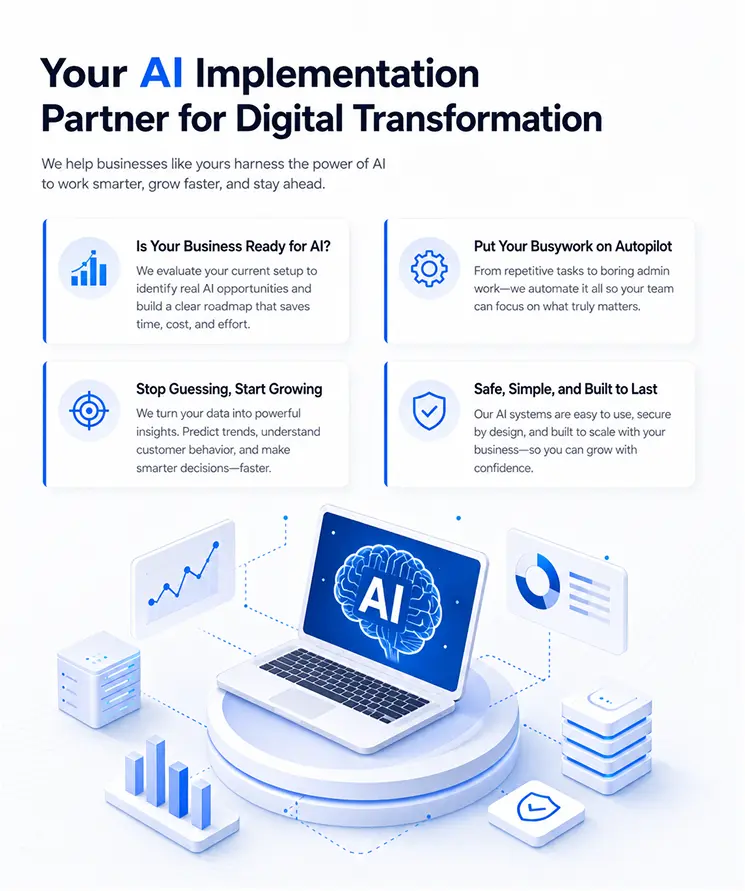
Artificial intelligence is no longer a “someday” technology. It’s already part of how businesses run, sell, and make decisions every day. From chatbots that answer customer questions to tools that predict what your customers want next, AI is quietly changing everything.
But where is all of this heading? What will AI adoption look like in the coming years, and how should your business prepare?
In this article, you’ll learn in simple words about the biggest future trends and predictions for AI service adoption, and what they mean for your business.
What Does “AI Service Adoption” Mean?
AI service adoption simply means how businesses start using AI tools and solutions in their daily work.
This can include things like chatbots, smart automation, data analysis tools, and AI-powered apps. Instead of building everything from scratch, many companies now “adopt” ready-made or custom AI services to save time and grow faster.
The goal is simple: work smarter, reduce costs, and give customers a better experience.

Why AI Adoption Is Growing So Fast
A few years ago, AI felt expensive and complicated. Today, it’s affordable, easier to use, and available to businesses of all sizes.
Here’s why more companies are adopting AI:
- It saves time by automating repetitive tasks
- It helps make faster, data-backed decisions
- It improves customer service around the clock
- It reduces long-term operational costs
- It gives smaller businesses a way to compete with big ones
As tools get simpler and cheaper, even small businesses are finding real value in AI.
Top Future Trends in AI Service Adoption
The next phase of AI won’t just be about having the technology. It’ll be about using it in smarter, more practical ways. Here are the key trends to watch.
AI Becomes Part of Everyday Business Tools
In the future, AI won’t feel like a separate “add-on.” It will be built directly into the software businesses already use, like email, CRMs, and accounting tools.
This means teams will use AI features without even thinking of them as AI. It’ll just be part of how work gets done.
Rise of Industry-Specific AI
General AI tools are useful, but the future belongs to AI built for specific industries.
We’ll see more AI made just for healthcare, finance, education, retail, and more. These tools will understand the unique needs of each field and deliver far better results than one-size-fits-all solutions.
More Focus on AI Agents and Automation
Instead of tools that just answer questions, businesses will adopt AI “agents” that can complete full tasks on their own.
For example, an AI agent might handle a customer request from start to finish, book a meeting, or manage a simple workflow without a human stepping in.
Stronger Focus on Data Privacy and Trust
As AI grows, so do concerns about data safety. In the coming years, businesses will care more about how AI handles their customer data.
Companies that use AI responsibly and protect user privacy will earn more trust and win more customers.
Low-Code and No-Code AI
Not every business has a team of developers. That’s why low-code and no-code AI tools are on the rise.
These let non-technical people build and use AI solutions with simple drag-and-drop tools. This trend will make AI adoption even faster across all business sizes.
Predictions for the Next Few Years
Looking ahead, a few clear predictions stand out for AI service adoption.
- Most businesses will use some form of AI in daily operations
- Customer service will be largely AI-assisted, with humans handling complex cases
- Personalised experiences will become the new normal for customers
- AI budgets will grow as companies see real returns
- Businesses that delay AI adoption may struggle to keep up with competitors
The message is clear: AI is moving from “nice to have” to “need to have.”
How Businesses Can Prepare for AI Adoption
You don’t need to adopt everything at once. Smart adoption happens step by step.
Here’s how to get started the right way:
- Identify slow or repetitive tasks that AI could handle
- Start with one simple, high-impact area first
- Choose tools that fit your industry and goals
- Train your team so they feel confident using AI
- Work with experts if you’re unsure where to begin
Starting small and scaling up is often the safest and smartest approach.
Common Mistakes to Avoid
As businesses rush to adopt AI, some make avoidable mistakes.
Watch out for these:
- Adopting AI without a clear goal
- Ignoring data privacy and security
- Expecting instant results overnight
- Choosing tools that don’t fit your actual needs
- Not training the team to use the new tools
Avoiding these mistakes helps you get real value from AI, not just hype.
Benefits of Adopting AI Early
Businesses that adopt AI thoughtfully and early often enjoy strong long-term advantages.
Key benefits include:
- Faster day-to-day operations
- Better customer experience
- Smarter, data-driven decisions
- Lower long-term costs
- A stronger position against competitors
Early adopters don’t just keep up; they often lead their industry.
FAQs
What is AI service adoption in simple words?
It means businesses using AI tools and solutions in their daily work to save time, cut costs, and improve results.
Is AI adoption only for big companies?
No. Thanks to affordable and easy-to-use tools, small and medium businesses can now adopt AI just as easily as large ones.
Which industries will benefit most from AI?
Almost every industry will benefit, but healthcare, finance, education, retail, and customer service are seeing especially fast adoption.
Do I need a technical team to use AI?
Not always. Many low-code and no-code AI tools are designed for non-technical users, though experts can help with more advanced needs.
Is it too late to adopt AI for my business?
Not at all. It’s better to start now with a clear plan than to wait and fall behind competitors.
Final Thoughts
AI service adoption is no longer a future idea; it’s happening right now and growing fast. In the coming years, AI will become a normal part of how businesses operate, serve customers, and make decisions.
The businesses that succeed won’t be the ones that adopt every tool blindly. They’ll be the ones that adopt AI with a clear plan, the right tools, and a focus on real results.
Take your time, start small, and choose solutions that truly fit your goals. With the right approach to AI adoption, your business can stay ahead and grow stronger for years to come.