

Solution For Business Consultation


















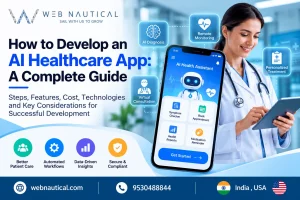
How to Develop an AI Healthcare App: A Complete Guide
Building an AI healthcare app starts with a question that has nothing to do with algorithms: what problem will this product actually solve for patients or healthcare teams?
Maybe a clinic spends hours answering routine appointment questions. Perhaps doctors are overwhelmed by documentation. Or a healthcare startup wants to help care teams spot concerning changes in readings from connected devices. Artificial intelligence can support all three situations, but each requires a different product, different data, and a different level of clinical oversight.
What Is an AI Healthcare App?
An AI healthcare app is a mobile or web application that uses artificial intelligence to perform a defined health-related task. It might organize information, answer routine questions, identify patterns in data, draft notes, or support a healthcare professional’s decisions.
The important distinction is what happens after the app receives information. A conventional app may simply store a blood pressure reading. An AI-enabled app might compare readings over time and flag a pattern for a clinician to review. That does not mean the app has made a diagnosis. Its role depends on how the product is designed, tested, and intended to be used.
How Does an AI Healthcare App Work?
Most AI healthcare apps follow a straightforward flow. They receive information from an approved source, prepare it for processing, run a model or rules-based workflow, and show a result to the right person.
For example, a remote monitoring app could collect readings from a connected device, check for unusual changes, and send a notification based on a care team’s agreed protocol. Behind that simple experience are several components: data connections, secure storage, user permissions, AI services , an interface, and safeguards for errors or uncertain results.
Those safeguards matter. If the app cannot interpret a reading reliably, it should not pretend otherwise. Depending on the use case, it may need to ask for another measurement or route the issue to a qualified professional.
Types of AI Healthcare Applications
| Application | What it helps with | Example |
|---|---|---|
| Patient engagement | Making services easier to access | Appointment and reminder assistant |
| Virtual health assistance | Handling approved questions | Patient support chatbot |
| Clinical decision support | Organizing information for clinicians | Defined risk alerts |
| Medical imaging | Reviewing images for specific findings | Radiology workflow support |
| Remote monitoring | Following changes in measurements | Chronic-care monitoring dashboard |
| Clinical documentation | Reducing repetitive paperwork | Draft consultation notes |
| Predictive analytics | Estimating specific risks | Readmission risk model |
| Healthcare administration | Streamlining back-office tasks | Scheduling or claims assistance |
A useful product usually starts with one of these needs rather than trying to address all of them at once.
Benefits of AI in Healthcare App Development
AI can save time on repetitive work, make large volumes of information easier to review, and help patients receive timely guidance about routine processes. For a healthcare provider, that might mean fewer hours spent drafting notes. For a patient, it could mean a simpler way to arrange a follow-up visit.
Still, benefits should be measured, not assumed. A chatbot that creates extra work for reception staff is not an improvement. A predictive model that generates too many false alerts can make clinical workflows harder. Set a baseline before launch and evaluate whether the app actually makes the intended task easier, safer, or more efficient.
Why Invest in AI Healthcare App Development?
Healthcare organizations are under pressure to deliver accessible services while managing documentation, staffing, and operational demands. AI is worth considering when it addresses one of these concrete pressures.
US hospitals have already begun adopting predictive AI within electronic health record workflows. A September 2025 brief from the Assistant Secretary for Technology Policy reported that the share of hospitals using predictive AI integrated with EHRs rose from 66% in 2023 to 71% in 2024. This finding concerns a specific type of hospital AI adoption; it should not be read as proof that every healthcare AI product is widely used.
For startups, potential opportunities include clinician documentation tools, patient communication, administrative automation, remote monitoring, and specialized data analysis. Before investing, speak to the people who would use and purchase the product. A technically impressive feature has limited business value if nobody needs it or the necessary data cannot be accessed legally.
Essential Features of an AI Healthcare App
Features should follow the use case. A patient scheduling app and a clinical imaging tool have very different requirements, even if both use AI.
AI-Powered Symptom Assessment
A symptom assessment feature can ask patients structured questions and help them understand what kind of support may be appropriate. It must communicate its limitations clearly. An unvalidated model should not deliver a confident diagnosis, and potentially urgent symptoms need a defined escalation path.
Personalized Health Recommendations
Personalization works well for lower-risk tasks such as reminders, educational material, or user-selected wellness goals. Recommendations about medication, treatment, or disease management are different: they may require clinical validation and stronger safeguards.
AI Chatbots and Virtual Assistants
A healthcare chatbot might explain clinic hours, guide a patient through booking, or answer questions using an approved information library. Restrict it to topics it can handle, test its answers, and make human support easy to reach. A conversational interface should never disguise uncertainty as medical certainty.
Predictive Analytics and Risk Assessment
Predictive models can estimate defined outcomes, such as missed appointments or readmission risk. The output should be evaluated against representative data and connected to a useful workflow. A risk score is information for review, not an automatic instruction about patient care.
Medical Image Analysis
Computer vision can help examine medical images for specific findings. This is a higher-stakes application that may need specialist assessment, substantial validation, and review of FDA requirements. The training data must reflect the people and settings where the tool will be used.
Clinical Documentation
AI can prepare draft visit notes or summarize lengthy records. Clinicians should be able to check sources, correct mistakes, and approve the final document. Inaccurate or invented details must not silently become part of a patient’s record.
Remote Patient Monitoring
An app connected to wearables or medical devices can help care teams review trends over time. It also needs to account for missed readings, faulty devices, poor connections, and alert fatigue. The design should make clear who responds to an alert and when.
Appointment Scheduling and Patient Support
Scheduling, reminders, and routine patient inquiries can be practical starting points for a first release. These features may involve less clinical risk than diagnosis or treatment recommendations, although privacy, security, and accessibility still matter.
How to Develop an AI Healthcare App Step by Step
There is no universal development process for every healthcare product. The following eleven steps provide a practical starting point for a US-focused team.
Step 1: Define the Problem and Business Goal
Write down the problem in plain language. For example: “Our clinicians spend too much time preparing visit notes,” or “Patients struggle to complete follow-up bookings.” Then decide how success will be measured. You might track documentation time, completed appointments, or the percentage of routine questions resolved without staff intervention.
Avoid starting with a feature list. Start with the outcome the feature is supposed to produce.
Step 2: Identify Your Users and Intended Use
Who uses the app every day? Who pays for it? Who reviews its outputs? A hospital administrator, physician, and patient may have very different expectations.
Map their existing workflow and identify where the app fits. Document the product’s intended use carefully because it affects design decisions, data access, clinical safety, and whether medical-device regulations may apply.
Step 3: Research the Market
Review competing products, but do not stop at comparing feature lists. Interview prospective users. Ask what slows them down, which tools they already use, and what would make them switch.
Pay attention to practical obstacles: procurement requirements, EHR compatibility, implementation effort, security reviews, and budget ownership. A smaller product that removes a frequent frustration can be more compelling than an ambitious platform with no clear buyer.
Step 4: Choose an MVP
Your minimum viable product should solve one useful problem with as little unnecessary complexity as possible. A clinic support app might begin with approved FAQ answers, appointment requests, and a staff dashboard.
Keep high-risk clinical functions out of the initial release unless the team has the data, expertise, validation plan, and regulatory strategy to support them. The goal is not to launch quickly at any cost; it is to test a focused product responsibly.
Step 5: Prepare the Healthcare Data
An AI model is only as useful as the information it receives. Identify where your data will come from, what permissions are required, and whether it can legally be used for development and evaluation.
Clean inconsistent records, address missing values, and separate training and testing data. Check whether the dataset represents the people the product is intended to serve. Removing names alone does not necessarily make health information safe to share or reuse.
Step 6: Select the AI Model and Technology Stack
Choose the technology that fits the job. Traditional machine learning may work well for a defined prediction task. Natural language processing can help extract information from documents. Generative AI may be suitable for drafting and conversation, while computer vision is relevant to image analysis.
Compare accuracy, latency, privacy controls, cost, vendor terms, and the ability to evaluate outputs. An existing model may be enough for an MVP. Custom model development makes sense when the task genuinely requires it, not simply because custom AI sounds more impressive.
Step 7: Design the User Experience
Healthcare interfaces must be clear under real-world conditions. Patients should understand what information is collected and why. Clinicians need a fast way to review AI-generated content and correct it.
Use readable language, accessible controls, clear consent flows, and straightforward navigation. Test early prototypes with representative users rather than assuming that a polished design will automatically be usable.
Step 8: Build the App and AI Infrastructure
A typical application includes a mobile or web frontend, authenticated APIs, secure databases, AI processing services, logging, and monitoring. Role-based access controls determine who can see or change information.
Where practical, separate the AI service from core application logic. That makes it easier to test or replace a model without rebuilding the whole product. Design for failures as well as normal operation: what happens if the AI service times out or returns an unusable answer?
Step 9: Integrate Healthcare Systems
If the app needs electronic health records, confirm what the target EHR actually supports before promising an integration. HL7 FHIR is an important standard for exchanging healthcare information, but real-world vendors vary in their supported resources, authentication processes, and workflows.
Specify exactly which records the app needs, test in approved environments, and plan for failed updates, conflicting information, and temporary service outages.
Step 10: Test Functionality, Security, and Clinical Safety
Test the software like any serious digital product: functionality, speed, accessibility, permissions, and security. Then test the AI separately. Review inaccurate answers, unexpected inputs, performance across relevant populations, and situations where the model should decline or escalate.
If outputs may affect clinical decisions, involve qualified healthcare professionals in evaluation and acceptance criteria. A convincing demo is not enough evidence for a high-stakes launch.
Step 11: Launch Carefully and Keep Monitoring
Begin with a controlled rollout, clear support responsibilities, and a rollback plan. Monitor uptime, user feedback, AI quality, security events, and the outcomes defined at the beginning of the project.
Model updates, new prompts, changing datasets, or revised workflows can alter behavior. Significant changes should be retested and assessed for any effect on validation or regulatory obligations.
How Much Does It Cost to Develop an AI Healthcare App?
The answer depends on what you are building. A small patient-support tool using an existing model will not have the same budget as a clinical platform that processes imaging data and integrates with several hospital systems.
For early planning, the following figures can help frame a discussion. They are illustrative estimates, not verified market averages or vendor quotes.
| Project complexity | Illustrative budget (USD) | Typical scope |
|---|---|---|
| Focused AI healthcare MVP | $40,000–$100,000 | Core application, limited AI functionality, essential security |
| Mid-complexity application | $100,000–$250,000 | Multiple workflows, dashboards, integrations, AI evaluation |
| Advanced platform | $250,000–$600,000+ | Complex AI, several user roles, substantial integration and validation |
| Specialized clinical AI | Scope-dependent; potentially above $600,000 | Custom clinical models and extensive evidence or regulatory work |
Large clinical studies, major regulatory programs, and proprietary data licensing can add substantially to these budgets.
What Do Individual AI Features Cost?
Feature-level planning estimates can also be useful:
| Feature | Illustrative additional budget (USD) |
|---|---|
| Existing model API integration | $5,000–$20,000 |
| Chatbot with controlled knowledge base | $10,000–$35,000 |
| Document extraction and summarization | $15,000–$50,000 |
| Predictive analytics | $25,000–$100,000 |
| Custom model development and evaluation | $40,000–$150,000+ |
These amounts overlap with broader project work and should not be added mechanically. Data preparation, infrastructure, security, and clinical validation may be priced separately.
Costs Beyond Development
Remember to budget for hosting, AI model usage, storage, backups, monitoring, support, and regular security work. A modest app might provision an illustrative 1,000–5,000 per month for infrastructure and technical operations; more demanding systems may cost far more. Actual costs depend on usage and staffing.
How to Keep the Budget Under Control
The most effective way to manage costs is to remove uncertainty early. Confirm data access and integration feasibility before major development begins. Build around one measurable use case, reuse proven components where suitable, and test risky assumptions with a controlled prototype.
Do not save money by skipping essential security controls or clinical review. Those shortcuts can make the product more expensive—and potentially unsafe—later.
What Affects the Final Development Cost?
Product complexity: More workflows, user roles, and AI features require more engineering and testing.
Model choice: An existing API may lower initial effort. Custom training and specialist evaluation increase the scope.
Data readiness: Clean, authorized data is easier to work with than fragmented records requiring extensive preparation.
Platform: A web-based internal tool may be simpler than supporting native iOS and Android apps with device connections.
Integrations: Every EHR, wearable, or external service introduces access, compatibility, and maintenance work.
Compliance and security: Privacy assessments, audit controls, clinical validation, and possible FDA-related requirements can materially affect the budget.
Team expertise: Healthcare experience, communication, and sound architecture matter alongside hourly development rates.
Best Technologies for AI Healthcare App Development
There is no single technology stack that suits every healthcare application. Select tools based on the product’s intended function, deployment needs, and security requirements.
Machine Learning Frameworks
PyTorch and TensorFlow can support model training and evaluation. scikit-learn is useful for many structured-data prediction and classification tasks. If a proven existing model already meets the requirements, building a model from scratch may not be necessary.
Natural Language Processing and Generative AI
NLP can help identify information in clinical documents or classify text. Generative models can prepare summaries, draft content, and power conversational experiences. Both need clear boundaries and testing for missing, incorrect, or fabricated information.
Cloud Infrastructure
Cloud services can provide secure storage, computing resources, databases, and monitoring. Choose providers and configurations based on access controls, encryption, reliability, and contractual obligations. If a provider handles electronic protected health information for a HIPAA-regulated organization, business associate requirements may apply.
FHIR and Healthcare APIs
FHIR-based APIs can make it easier to exchange standardized records, but vendor-specific integrations may still be necessary. Start by identifying the exact information and workflows the app needs rather than integrating every available endpoint.
Large Language Models and RAG
Retrieval-augmented generation (RAG) lets a language model reference content from an approved knowledge base. For example, a clinic assistant could consult current appointment instructions before answering a patient. RAG may improve relevance, but it does not eliminate incorrect answers. Use source references, content updates, permissions, and appropriate review.
AI Healthcare App Security, Privacy, and Compliance in the USA
Healthcare data deserves careful handling from the first design meeting. Security and compliance are not features to add just before release.
HIPAA: When Does It Apply?
HIPAA generally applies to covered entities and to business associates performing certain functions involving protected health information on their behalf. A consumer wellness app is not automatically subject to HIPAA simply because it collects health information. Other federal and state requirements may still apply.
Determine the organization’s role, what information the app processes, whether a business associate agreement is needed, and what additional privacy obligations exist. Seek qualified legal advice for the specific business model.
Encryption, Permissions, and Audit Trails
Use encryption, strong authentication, role-based permissions, secure key handling, backups, and incident response processes. Keep sensitive information out of logs unless it is genuinely necessary and appropriately protected. Review access regularly and test security throughout development.
Consent and Responsible Data Use
Explain what data the app collects, why it needs it, whether outside AI vendors process it, and what rights users have under applicable law. Confirm that vendor agreements and data practices match the product’s promises. De-identification and data minimization can reduce risk but do not replace legal review.
FDA Requirements for AI Medical Software
Not every healthcare app needs FDA clearance. The key questions concern intended use and functionality. Software designed for certain diagnostic or treatment purposes may fall under medical-device rules, while administrative and some general wellness functions may not.
Depending on the product, an appropriate regulatory pathway could involve 510(k), De Novo, or premarket approval. Evaluate this early with qualified specialists rather than assuming the answer based on the use of AI alone.
Bias, Hallucinations, and Human Oversight
AI can produce convincing but incorrect information, and model performance can differ across populations or settings. Use representative evaluation data, clear limitations, fallback behavior, and practical human review. Clinicians must be able to understand, correct, and override relevant outputs.
How Long Does It Take to Develop an AI Healthcare App?
A focused MVP may take around 3–6 months. A more integrated product may require 6–9 months, while a complex clinical platform may take 9–18 months or longer. These are illustrative schedules, not industry averages or delivery promises.
| Stage | Illustrative duration |
|---|---|
| Discovery and requirements | 2–4 weeks |
| UX research and design | 2–6 weeks |
| Data assessment and AI prototype | 3–10 weeks |
| Core development | 6–16 weeks |
| Integration and security | 3–10 weeks |
| Testing and validation | 3–8 weeks |
| Deployment and early monitoring | 1–3 weeks |
Stages often overlap, and clinical studies, regulatory submissions, procurement, or difficult integrations can extend the schedule considerably.
To avoid unnecessary delays, confirm data access, identify the decision-makers, secure test environments, and agree on MVP acceptance criteria before development begins.
How Do AI Healthcare Apps Make Money?
The right revenue model depends on who benefits and who controls the budget.
Subscriptions: Consumer wellness or organizational tools may offer monthly or annual plans. Pricing needs to reflect real ongoing value and comply with applicable consumer rules.
Provider licensing: Clinics and hospitals may pay to use software across teams or facilities, often with implementation and support fees.
B2B contracts: Enterprise agreements may be annual, usage-based, or tied to users or locations. Buyers often expect clear security, integration, service-level, and data-responsibility terms.
Premium capabilities: Advanced reporting, additional integrations, or specialized workflow automation can support higher-value tiers. Avoid pricing incentives that could encourage unnecessary clinical services.
Common Challenges in AI Healthcare App Development
Access to usable data. Healthcare records may be inconsistent, fragmented, or difficult to access. Validate permissions and quality before choosing the final model architecture.
Reliable AI performance. A model that works well in a demo may behave differently in a real clinic. Test with representative information and monitor after launch.
Privacy and cybersecurity. Protect patient information through secure engineering, access controls, vulnerability management, and incident response.
Integration with existing systems. EHRs and legacy tools can vary widely. Confirm what each vendor supports and plan for interruptions or inconsistent data.
Regulatory clarity and trust. Be transparent about what the AI does, what it cannot do, and when a qualified person reviews its output. Make sure marketing claims match the product’s actual capabilities.
How to Choose an AI Healthcare App Development Company
A development partner should understand both software engineering and the practical realities of healthcare. Ask how the team handles data permissions, model evaluation, secure architecture, integrations, and post-launch monitoring.
Review relevant projects and request genuine examples with clearly explained outcomes. Ask what was difficult, how it was addressed, and what limitations remained. A polished portfolio alone is not evidence of clinical or regulatory expertise.
Discuss HIPAA and potential FDA considerations in concrete terms. A broad claim that a product is “HIPAA compliant” is not a substitute for reviewing system controls, responsibilities, and agreements.
Finally, compare written proposals on scope, exclusions, milestones, testing, ongoing operating costs, and support—not just the initial price. A low quote may leave out important work that appears later as an unexpected expense.
Future Trends in AI Healthcare Apps
Healthcare Copilots
AI copilots may increasingly help teams draft notes, retrieve approved information, and manage administrative tasks. Their usefulness will depend on reliability and fit with existing workflows.
Predictive and Preventive Tools
Predictive models may help care teams notice changes earlier, but predictions are not diagnoses. Clinical value depends on validation and an appropriate response process.
Smarter Remote Monitoring
Connected devices combined with AI could make it easier to review large volumes of measurements. Teams will still need reliable devices, sensible alert thresholds, and clear escalation responsibilities.
More Personalized Experiences
Apps may tailor reminders, educational material, and support to a user’s preferences and authorized information. Personalization should remain understandable and should not make unsupported medical claims.
Multimodal AI
Systems that work with text, images, audio, and structured records may enable richer clinical workflows. They also introduce additional testing, privacy, and error-management challenges.
Frequently Asked Questions
How Much Does It Cost to Develop an AI Healthcare App?
For early planning, a focused MVP might be budgeted at 40,000–100,000, an integrated app at 100,000–250,000, and an advanced platform at 250,000–600,000 or more. These are illustrative estimates. Actual costs depend on scope, data, integrations, and regulatory needs.
How Long Does Development Take?
A focused MVP may take 3–6 months. Complex products may take 6–18 months or longer, particularly when clinical validation or difficult integrations are involved.
What Features Should Be Included First?
Begin with features that solve the core problem: secure login, relevant workflows, useful AI support, and the minimum integrations needed. Add higher-risk clinical functions only when the required evidence and safeguards are in place.
Can Generative AI Be Used in Healthcare Apps?
Yes. It can assist with summaries, documentation, approved information retrieval, and patient communication. Sensitive information needs protection, and potentially consequential outputs require appropriate testing and review.
Do All Healthcare Apps Need HIPAA Compliance?
No. HIPAA applicability depends on the organization and its role in handling protected health information. Other privacy laws may still apply even when HIPAA does not.
Does an AI Healthcare App Need FDA Clearance?
Not always. The answer depends on the product’s intended use and functionality. Some diagnostic or treatment-related functions may require an FDA regulatory pathway.
Should We Use an Existing AI Model or Build One?
Use an existing model when it meets your requirements for performance, privacy, and cost. Consider custom development when a specific task cannot be served adequately by available options. Evaluate both choices with representative data.
Conclusion
A successful AI healthcare app is not simply an app with an AI feature attached. It is a product designed around a real healthcare problem, supported by appropriate data, built with strong security, and tested for the way people will actually use it.
Start with a focused use case. Confirm the available data and integrations. Choose technology that fits the job, and make room in the plan for privacy, clinical oversight, and ongoing maintenance. Those decisions have more influence on long-term success than adding the latest model or the largest possible feature list.
If your business is planning an AI-powered healthcare product, Web Nautical can be a starting point for discussing the idea, desired features, development scope, and next steps. Any project involving clinical functionality should also involve appropriately qualified healthcare, privacy, and regulatory professionals.